Bürokratt
Bürokratt is Estonia’s national AI initiative — a government-wide platform for building and managing AI assistants across public institutions.
project
Bürokratt is Estonia’s national AI initiative — building the shared infrastructure for AI-powered public services across government.
Citizens see the conversation. But my focus is the system behind it: the tools case workers and administrators use to configure, monitor, and improve how AI assistants respond.
I joined a product that had evolved without dedicated design involvement. Workflows were complex, design files fragmented, and the same system had to work for institutions with very different needs and scales.
My job was to understand how it all worked, give it structure, and translate that complexity into Vera — Estonia’s shared design system for public digital services.
-
I joined Bürokratt as a product and UX design partner, working part-time with the team on the back-office behind Estonia’s national AI assistant network.
My focus is the system behind the conversation: the tools case workers and administrators use to configure, monitor, and improve how AI assistants respond to citizens.
I entered a product that had evolved without dedicated design involvement — complex workflows, fragmented design files, and very different institutional needs. My job was to understand the system, give it structure, and translate that complexity into Vera, Estonia’s shared design language for public services.
One of the core challenges is scale. The same product needs to work for institutions managing just a few domains and for those managing close to a hundred.
The work is ongoing: simplifying that complexity into a back-office that remains understandable at both ends of the spectrum.
-
Team
Product development is coordinated by the Estonian Information System Authority (RIA / NCSC-EE), working with multiple external development partners — typically small, 3–5 person engineering teams.Scope
Back-office tools used across Estonian state institutions to configure and manage AI assistants, case handling, and the workflows behind citizen-facing services — designed within Estonia’s shared Vera design system.
-
Designing without a blank canvas
The challenge wasn’t a lack of possibilities. It was the lack of freedom.
Bürokratt operates within Estonia’s national design framework, Vera. Colors, typography, components, interaction patterns, and much of the structure were already defined. Content requirements and user stories added another layer of constraints.
At the same time, parts of the back office had evolved without dedicated design involvement. Workflows were technically driven, concepts were abstract, and understanding what the system was doing often required understanding how it worked underneath.
My job wasn’t to redesign the rules. It was to find clarity, simplicity, and a more human experience within them.
-
1 — Make performance visible
Conversation history contained the data, but not the understanding.
It was difficult to see how Bürokratt was actually performing: how many conversations the AI resolved on its own, how often a human advisor had to step in, how users rated the responses, or how those signals changed over time.
I redesigned the overview around those questions rather than the underlying data structure — bringing conversation volume, AI-vs-advisor resolution, and response ratings into one scannable view.
The goal was simple: understand how the assistant is doing without having to investigate it.
2 — Hide technical complexity, not control
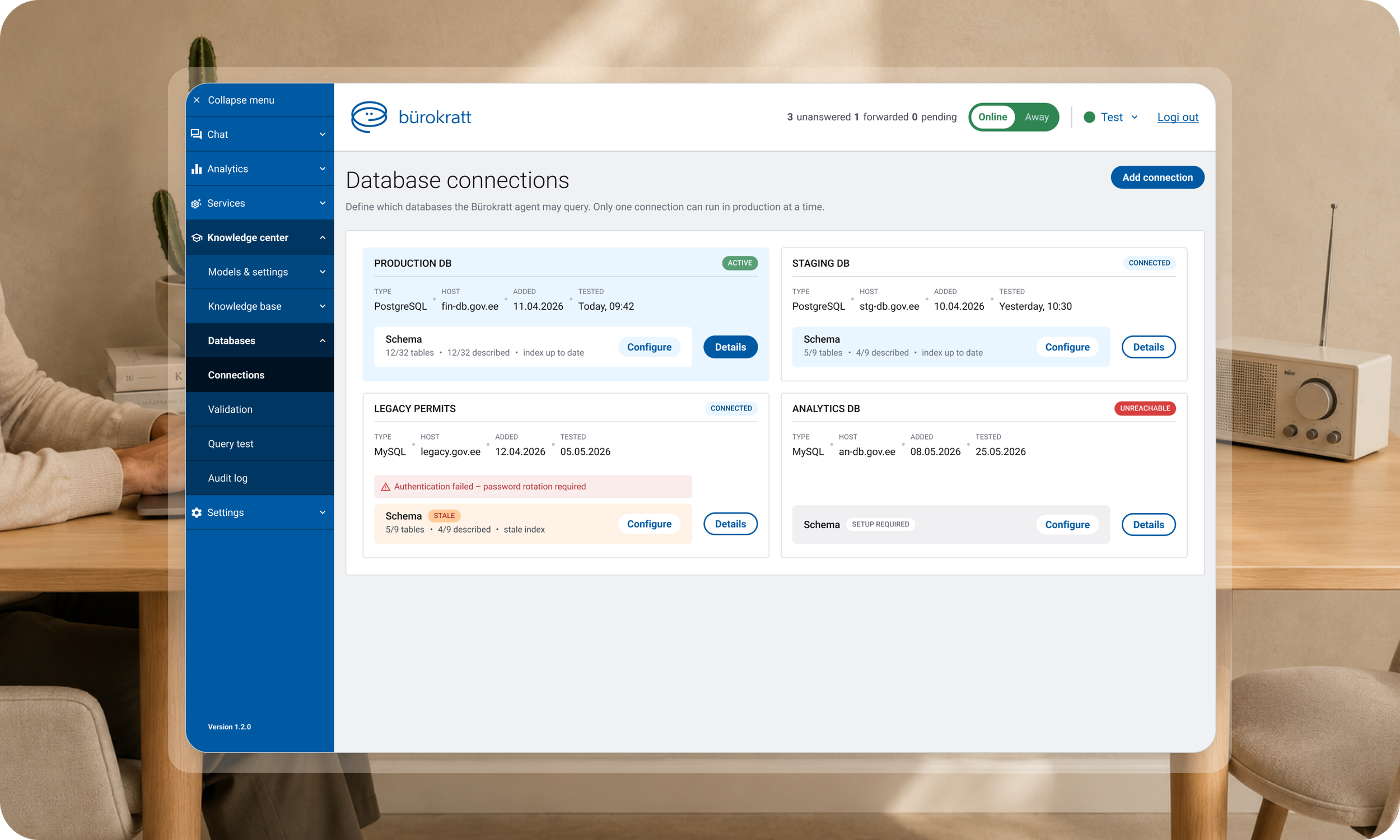
Managing LLMs and data sources exposed too much of the system’s technical structure to the people using it.
I reworked these workflows around what administrators were trying to accomplish rather than how the underlying technology was organized — simplifying terminology, hierarchy, and interactions while preserving the control needed to configure and manage an AI assistant.
The challenge was not to make the technology appear simple. It was to make its complexity manageable.
Simplify the mental model, not the capability.
-
Designing inside Vera
There was no new visual language to invent. There was an existing one to make work.
Bürokratt follows Vera, Estonia’s shared design system for public digital services. The core visual language — colors, typography, components, buttons, and interaction patterns — was already established.
That shifted the design challenge from visual invention to careful composition: using hierarchy, spacing, information density, data visualization, and familiar interaction patterns to make technically complex workflows feel clear and contemporary.
The constraint became the design tool.
Instead of making Bürokratt look different, the goal was to make it feel simpler.
Results
I helped make Bürokratt’s back office clearer, simpler, and more human — improving how public servants understand conversation performance and how administrators configure the AI and its data.
The work is ongoing, but the direction is consistent: less technical abstraction, clearer workflows, and more confidence about what the system is doing and what happens next.
The more a system decides on its own, the more its interface has to earn trust.
Design principle